Closing the Loop: How Stone Recycling Works in Construction
In an era focused on sustainability and circular economies, the construction industry is seeking ways to reduce its environmental footprint. One of the most effective strategies is material recycling, and natural stone is a prime candidate for a second life. The inherent durability of stone means it never truly wears out; it simply awaits a new purpose.
At Iran Stone Market, we believe sustainability begins with choosing materials built to last. Understanding the journey of stone recycling highlights why investing in high-quality, durable natural stone from the start is the most responsible choice you can make.
The Lifecycle of Stone: From Quarry to Reincarnation
Stone recycling is the process of reclaiming, processing, and reusing natural stone from demolition sites, construction off-cuts, and fabricator waste. This process gives beautiful and valuable material a new life, diverting it from landfills and reducing the need for virgin quarrying.
The recycling journey typically follows these paths:
Path 1: Direct Reclamation & Reuse (The Highest Value)
This is the most desirable form of recycling. Large, intact slabs or carefully dismantled stone pieces are salvaged from old buildings, monuments, or even leftover fabricator inventory.
-
The Process:
-
Careful Demolition: Instead of wrecking balls, deconstruction crews carefully remove stone cladding, flooring, or countertops to preserve their size and integrity.
-
Inspection & Cleaning: The stone is inspected for damage, cleaned of old mortar and adhesives, and its edges may be re-finished.
-
Reintroduction to Market: The stone is sold as “reclaimed” or “antique” material, often at a premium due to its unique character and patina.
-
-
Common Uses: Feature walls in new buildings, high-end residential projects seeking a historic feel, restaurant interiors, and landscape design.
Path 2: Crushing for Aggregate (The Most Common)
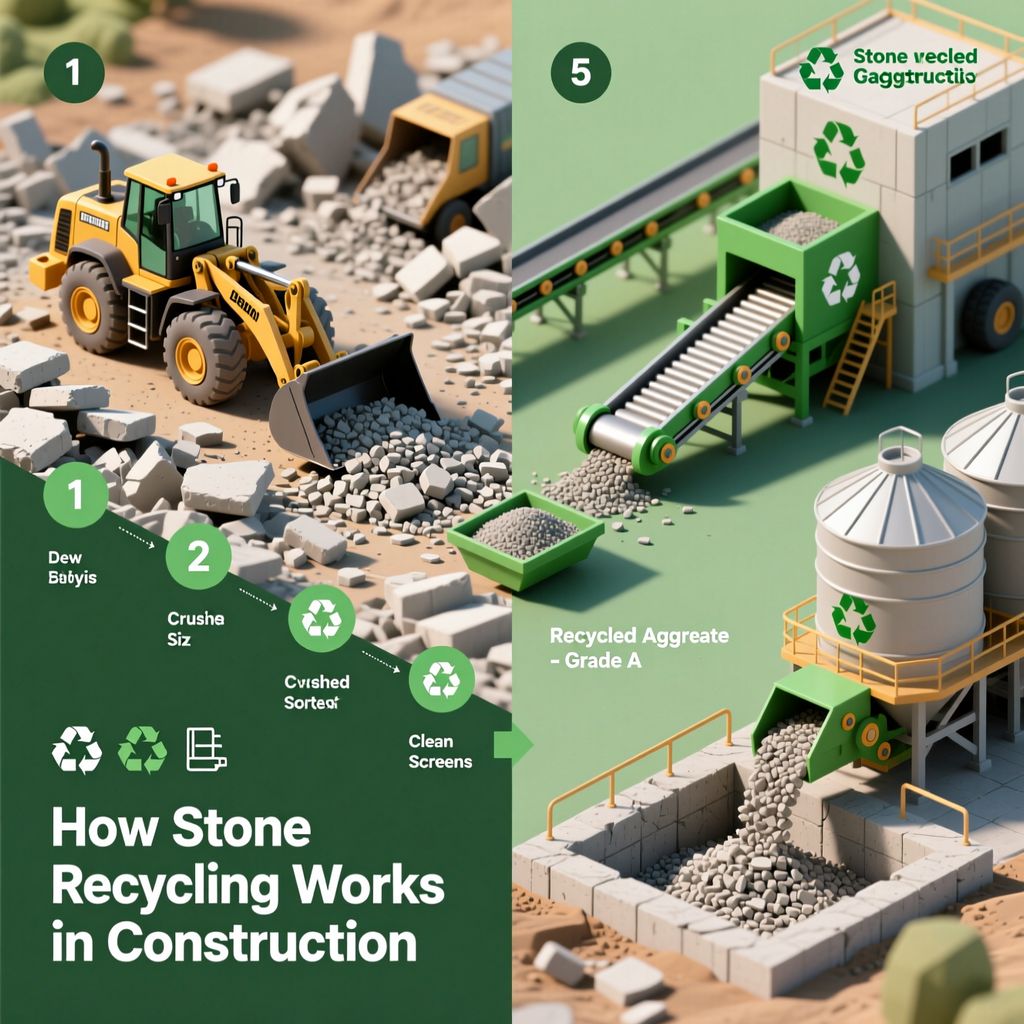
When stone is broken, damaged, or exists as small off-cuts, its most common destination is the crusher.
-
The Process:
-
Collection & Sorting: Stone waste from fabricator yards and construction sites is collected and sorted by type (e.g., marble, granite).
-
Crushing & Sizing: The stone is fed into industrial crushers and screened to produce different sizes of aggregate, from fine gravel to larger crushed stone.
-
-
Common Uses:
-
Construction Aggregate: Used as a base layer for roads, pathways, and building foundations.
-
Landscaping: Decorative gravel, drainage beds, and garden paths.
-
New Composite Materials: Crushed stone is a key component in terrazzo flooring, engineered quartz, and concrete.
-
Path 3: Grinding for Powder & Fillers
The finest grade of crushed stone can be ground into a powder.
-
The Process: The crushed aggregate is further pulverized into a fine, white powder.
-
Common Uses:
-
Agricultural Lime: Used to neutralize acidic soils.
-
Manufacturing Fillers: Added to paints, plastics, and adhesives as a filler and pigment.
-
Animal Feed Supplement: Provides essential calcium and other minerals.
-
The Proactive Choice: Durability as the Ultimate Form of Recycling
While recycling is crucial, the most sustainable approach is to generate less waste in the first place. This is where the unparalleled durability of natural stone shines.
When you source high-quality stone from Iran Stone Market, you are making a long-term investment that inherently supports sustainability:
-
Longer Lifespan: A granite countertop or travertine floor won’t need to be replaced in 10-20 years. It can last for generations, meaning it won’t enter the waste stream for a very long time.
-
Timeless Aesthetics: The classic beauty of natural stone doesn’t go out of style. Unlike trendy materials, it doesn’t get ripped out during a simple style refresh, again extending its life.
-
Less Processing Over Time: A durable material that doesn’t require replacement avoids the repeated environmental costs of manufacturing, transportation, and installation of new materials over decades.
Our Role in a Sustainable Stone Cycle
As a direct exporter of premium Iranian stone, we contribute to this cycle by:
-
Providing Durable, Long-Lasting Material: Our marble, travertine, and granite are selected for their structural integrity and timeless beauty, designed to be used for a lifetime.
-
Efficient Processing: We optimize our cutting processes to maximize yield from each block, minimizing off-cuts at the source.
-
Supporting the Chain: We advocate for and support the development of stone reclamation and recycling initiatives within the industry.
Build with the Future in Mind
By choosing natural stone, you are not just selecting a beautiful material—you are investing in a resource that can be repurposed for centuries to come.
Partner with Iran Stone Market for stone that is as durable as it is beautiful. Build a legacy, not landfill.