As an architect, your material selections are foundational to a project’s aesthetic, performance, and longevity. When specifying natural stone for cladding, flooring, or features, marble and limestone are two classic options that often come to the fore. While they may share a light-colored palette, their fundamental properties differ significantly.
Understanding the key differences between marble and limestone is crucial for making an informed decision that aligns with your design vision and technical requirements. This guide provides a detailed, professional comparison to help you specify with confidence.
At a Glance: The Fundamental Distinction
The core difference lies in their geological formation:
-
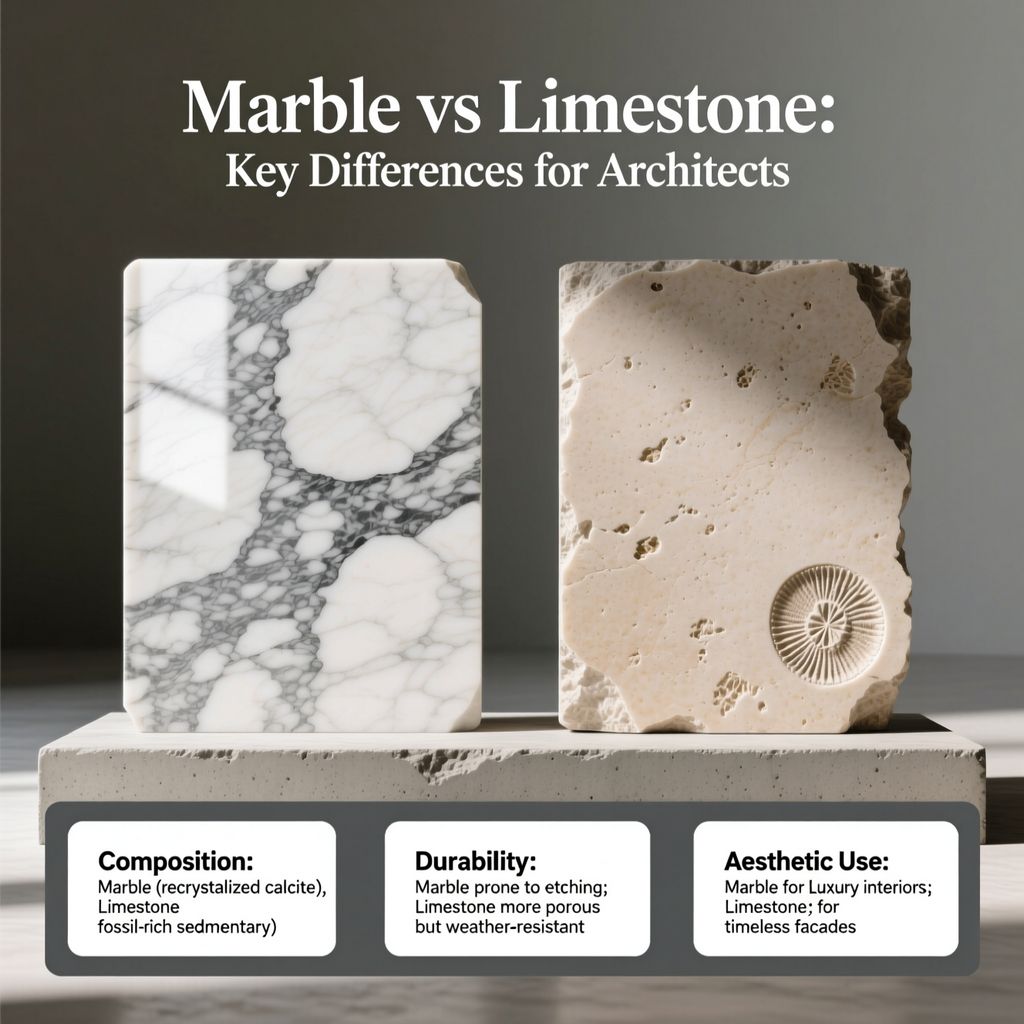
Limestone is a sedimentary rock. It forms from the accumulation of shell, coral, algal, and fecal debris in marine environments. It is primarily composed of the mineral calcite.
-
Marble is a metamorphic rock. It begins as limestone or dolomite and is transformed by immense heat and pressure within the earth’s crust. This process, called recrystallization, changes the stone’s structure and typically introduces the iconic veining.
Detailed Comparison: Marble vs. Limestone
| Feature | Limestone | Marble |
|---|---|---|
| Geological Class | Sedimentary Rock | Metamorphic Rock |
| Hardness (Mohs Scale) | Softer (3-4) | Harder (4-5) |
| Durability & Wear | Good, but can be prone to abrasion and etching. | Good hardness, but highly susceptible to etching. |
| Porosity | Generally more porous; requires sealing. | Less porous than limestone, but still requires sealing. |
| Aesthetic & Appearance | Typically uniform, earthy, and subtle with a matte to honed finish. Fossils are common. | Crystalline, polished look with dramatic, often colorful veining. |
| Color Range | Tans, beiges, grays, buffs. Consistent tones. | Wide range: whites, grays, blacks, greens, pinks. Distinct veining. |
| Primary Applications | Cladding, flooring, pavers, carved details, hearths. | Flooring, wall cladding, countertops, vanities, feature walls. |
| Etching Resistance | Low (etches from acids like vinegar, lemon juice). | Very Low (easily etched by acids). |
| Cost Considerations | Generally more cost-effective than marble. | Typically more expensive due to demand and quarrying complexity. |
Deep Dive for Architectural Specification
1. Composition and Aesthetics: Setting the Design Tone
-
Limestone: Offers a more subdued and organic aesthetic. Its earthy, muted tones and often fossilized details create a sense of history and tranquility. It excels in projects aiming for a rustic, traditional, or understated modern look. The finish is often honed, brushed, or tumbled to enhance its natural texture.
-
Marble: Is synonymous with luxury and drama. The recrystallization process creates unique, flowing veins of color against a contrasting background. This makes each slab a one-of-a-kind piece of art. It is the premier choice for creating bold statements, from a grand lobby floor to a sleek, modern bathroom vanity, and is most famously associated with a high-gloss polish.
2. Durability and Performance: Critical for Project Success
This is where the choice becomes highly project-specific.
-
Limestone: While softer, its uniform composition can make it less likely to crack or fissure under pressure compared to some veined marbles. It is an excellent choice for high-traffic flooring (when properly sealed and finished honed) and exterior cladding, as it weathers gracefully. However, its porosity makes it vulnerable to staining in kitchens or outdoor dining areas.
-
Marble: Its harder surface is more resistant to scratching than limestone. However, its primary weakness is its acute susceptibility to etching. Acidic substances (wine, coffee, cleaning products) will permanently dull the polished surface, leaving a light mark. This makes it a challenging choice for kitchen countertops but a timeless one for low-traffic, luxurious bathrooms and feature walls.
Architect’s Note: For both stones, a program of regular sealing with an impregnating sealant is non-negotiable to resist stains.
3. Applications and Use Cases: Where to Specify Each Stone
Choose Limestone For:
-
Exterior Cladding & Facades: Its weather-ability and uniform appearance make it ideal.
-
Paving & Patios: A honed or thermal finish provides slip resistance.
-
High-Traffic Commercial Flooring: A honed finish hides wear and tear better than a polished surface.
-
Fireplace Surrounds & Hearths: Where a rustic, warm aesthetic is desired.
Choose Marble For:
-
Bathroom Vanities & Walls: Creates a spa-like, luxurious atmosphere with minimal exposure to acids.
-
Feature Walls & Accents: To showcase the stone’s dramatic veining as a focal point.
-
Lobby Flooring & Staircases: In commercial or high-end residential projects where a statement of opulence is key.
-
Historic Restoration: When authenticity to the original design is required.
The Verdict: Which Stone is Right for Your Project?
The choice between marble and limestone isn’t about which is “better,” but which is more appropriate for the specific application and design intent.
-
Specify Limestone when your project demands understated elegance, historical context, and proven performance in exterior or high-traffic interior applications. It is the workhorse of the two, offering durability and a consistent, earthy aesthetic.
-
Specify Marble when the design calls for dramatic visual impact, unparalleled luxury, and a unique, veined canvas. It is best reserved for interior features and surfaces that will not be subjected to acidic conditions, where its beauty can be preserved for generations.
By weighing these key differences in composition, performance, and aesthetics, you can leverage the unique qualities of both marble and limestone to create spaces that are not only beautiful but also built to last.