The Ultimate Guide: How to Avoid Fake Marble in the Market
Marble has been a symbol of luxury and elegance for centuries. Its unique veining and cool touch are unmatched, making it a top choice for homeowners and designers. However, its popularity has led to a proliferation of imitations in the market. For the untrained eye, distinguishing real natural marble from clever fakes can be challenging.
This guide will equip you with the knowledge on how to avoid fake marble in the market, ensuring your investment brings lifelong beauty and value. As direct exporters of premium Iranian marble, IranStoneMarket.com is committed to transparency and authenticity.
What is “Fake Marble”? Understanding the Alternatives
When we say “fake marble,” we typically refer to three types of products:
-
Cultured Marble: A man-made product made from marble dust mixed with polyester resins and pigments. It’s poured into molds to create slabs or vanity tops.
-
Porcelain or Ceramic Tiles: High-definition printing technology can create tiles that mimic the look of marble remarkably well.
-
Quartz Surfaces: Engineered stone made from about 90% ground quartz and 10% resins and pigments. Some designs are made to look like marble.
While these are valid materials for certain applications, they should never be sold as natural marble.
The 5 Tell-Tale Signs: How to Spot Real vs. Fake Marble
Use these simple tests to identify genuine natural marble.
1. The Visual Test: Look for Uniqueness and Imperfections
-
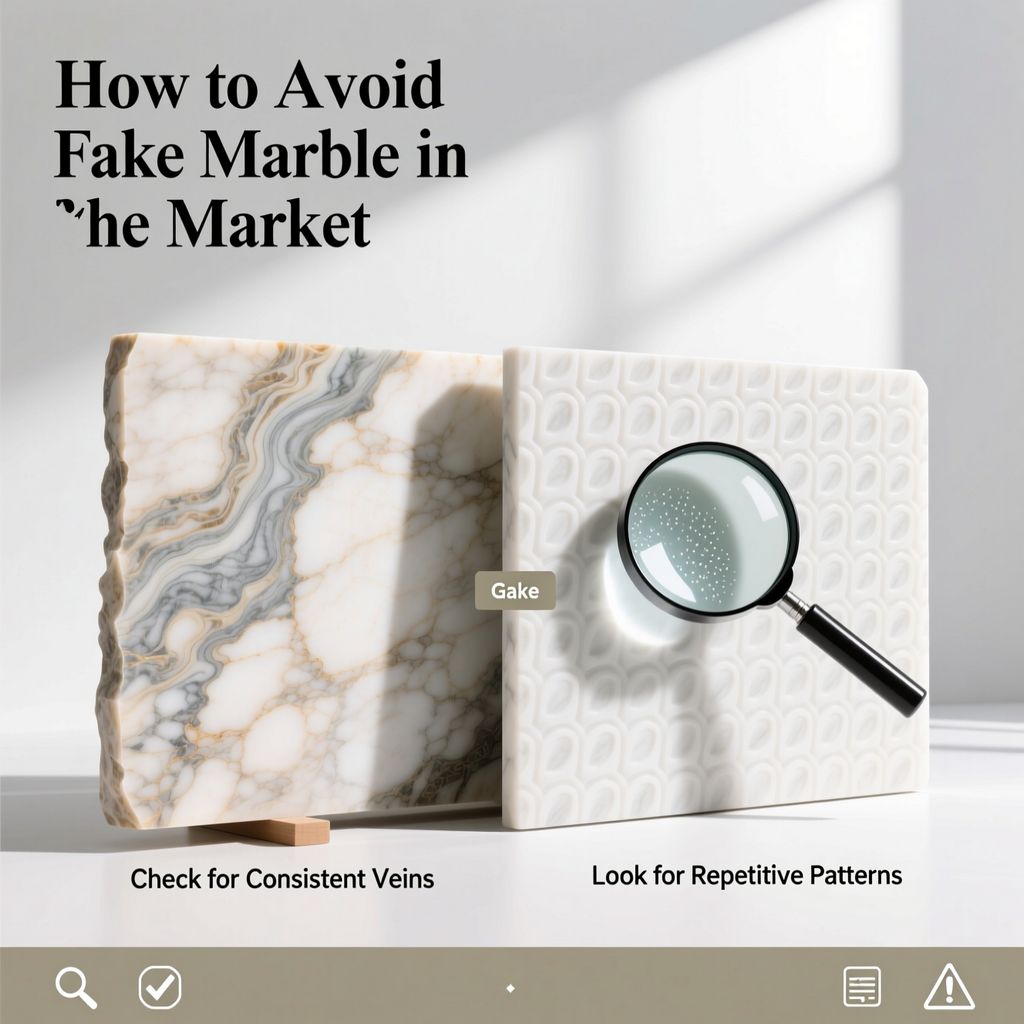
Real Marble: No two slabs are identical. Look for random, organic veining that flows through the stone in unique patterns. You will find natural fissures, color variations, and subtle imperfections. The veining is inside the stone, not on the surface.
-
Fake Marble (Cultured/Quartz): Patterns are often repetitive. If you look at multiple slabs of the same “type,” you may see the same vein pattern repeating. The look can be too perfect or uniform.
-
Fake Marble (Tile): The printing pattern repeats exactly from one tile to the next. Look closely at the grout lines; the pattern may not line up naturally.
2. The Touch Test: Feel the Temperature
-
Real Marble: Is naturally cool to the touch because it is a dense, natural stone. It conducts heat away from your hand.
-
Fake Marble (Cultured/Quartz): Feels lukewarm or room temperature because the resin content acts as an insulator.
-
Fake Marble (Tile): Also feels cool, but the glaze on top can have a different texture than honed or polished stone.
3. The Scratch Test (Do with Caution)
-
Real Marble: Is a calcium-based stone and is relatively soft. It can be scratched by a sharp metal object like a key or knife. A genuine supplier will never let you do this on a finished slab, but you can ask to test on a sample or a leftover piece.
-
Fake Marble (Quartz): Is much harder and more resistant to scratching due to its high quartz content.
-
Important Note: Always perform this test on a hidden area or a sample, never on a display piece without permission.
4. The Water Absorption Test
-
Real Marble: Is porous. If you place a few drops of water on it, the water will be absorbed slowly and leave a dark spot. This is why marble requires sealing.
-
Fake Marble (Cultured/Quartz): Are non-porous due to the resin. Water will bead up on the surface and not be absorbed.
5. The Acid Test (The Most Definitive)
-
Real Marble: Is sensitive to acids. A drop of a mild acid like lemon juice or vinegar will cause it to fizz or etch, leaving a dull mark. This is a key characteristic of calcite-based stones.
-
Fake Marble (Quartz): Is highly resistant to acids. The drop will have no effect.
-
Warning: This test will damage the surface of natural marble. Only perform it on a sample you own or with explicit permission on a waste piece.
How to Protect Yourself When Buying Marble
-
Buy from a Reputable Source: Always purchase from established and trusted suppliers and fabricators. Check their reviews and ask for their source quarries.
-
Ask the Right Questions: Directly ask, “Is this 100% natural marble?” Ask for the specific name and origin of the stone (e.g., “Iranian Travertine,” “Carrara White”).
-
Visit the Stone Yard: If possible, go to see the actual slabs you are purchasing. This allows you to perform visual and touch tests and choose the exact unique piece you love.
-
Request a Material Certificate: A professional supplier should be able to provide documentation confirming the stone’s natural origin and type.
-
Be Wary of Prices That Are Too Good to Be True: High-quality, natural marble has a certain cost. A price significantly lower than the market average is a major red flag for an imitation product.
Why Choose IranStoneMarket.com for Guaranteed Authenticity
When you source from us, you eliminate the risk of counterfeit products.
-
Direct from the Quarry: We are exporters based in Iran, with direct access to some of the world’s most beautiful marble quarries. We provide full transparency from the source.
-
100% Natural Stone Guarantee: We deal exclusively in genuine, natural stone. We never sell cultured or engineered products.
-
Transparent Process: We provide high-quality videos and photos of our blocks and slabs, and we encourage inspections so you can see the raw beauty of the stone for yourself.
-
Expert Knowledge: Our team can tell you the geological composition and properties of each stone we sell.
Invest in Real Beauty, Invest in Real Marble
Knowing how to avoid fake marble in the market empowers you to make an informed decision. While imitation products have their place, nothing can replicate the timeless, unique, and valuable nature of genuine marble.
Don’t compromise on authenticity for your next project.
Contact IranStoneMarket.com today. Let us provide you with certified, 100% natural Iranian marble that will bring authentic elegance and lasting value to your space.
[Request Genuine Iranian Marble Samples from IranStoneMarket.com!]