
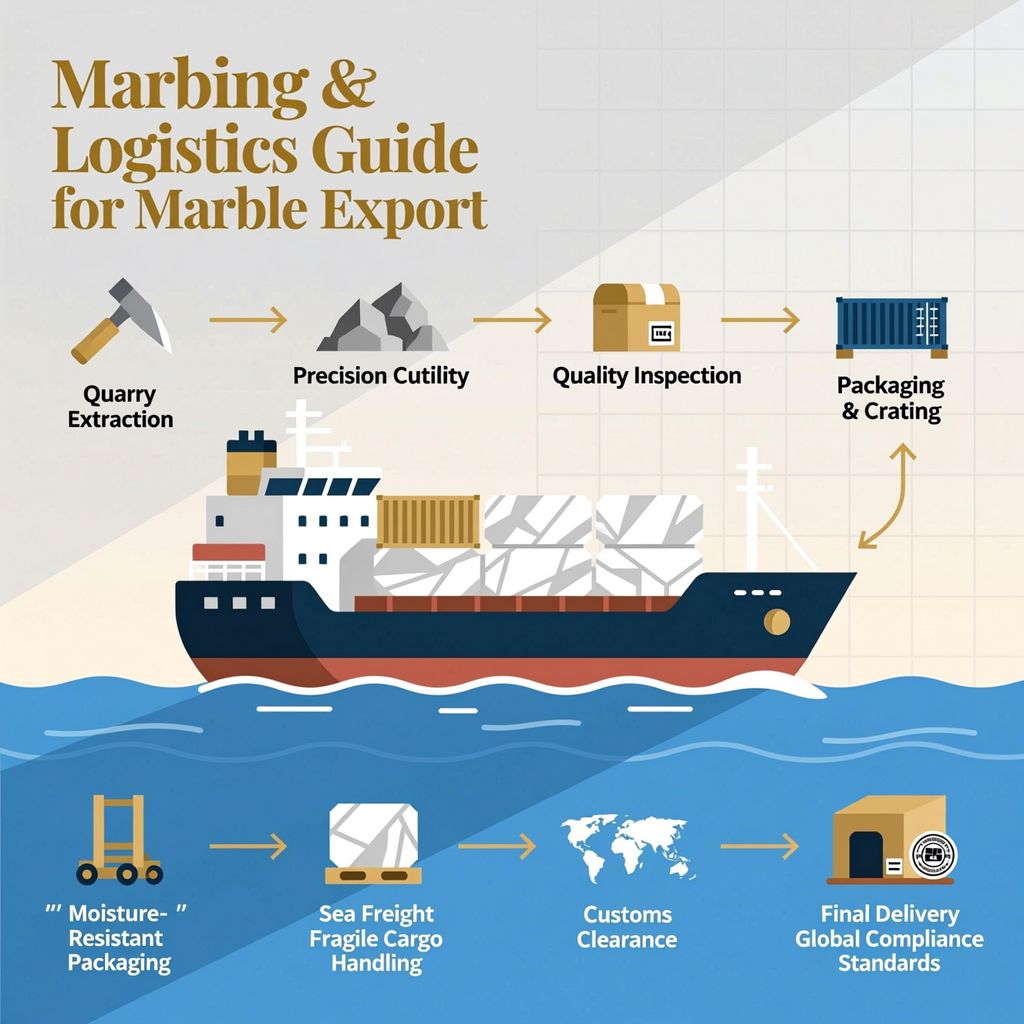
Navigating the Journey: Your Complete Shipping and Logistics Guide for Marble Export
Exporting marble is more than just selling a beautiful product; it’s about ensuring that product arrives at its destination in perfect condition, on time, and within budget. The shipping and logistics for marble export can seem complex, but with the right knowledge and partner, it becomes a smooth and reliable process.
This definitive guide breaks down every step, from our quarry in Iran to your project site anywhere in the world. As a leading exporter, IranStoneMarket.com has mastered this pipeline, and we’re sharing our expertise to help you plan with confidence.
Phase 1: Pre-Shipment Preparation – The Foundation of Safe Transit
1. Professional Packaging: The First Line of Defense
How we pack your marble is critical to its safe arrival.
-
Marble Slabs: Each slab is individually protected with foam or corrugated cardboard. They are then stacked on a sturdy wooden crate (an A-frame pallet), separated by protective spacers, and securely strapped with steel or plastic bands. Corner guards are applied to prevent chipping.
-
Marble Blocks: Blocks are carefully placed in steel-framed wooden crates and secured to prevent movement during transit.
-
Tiles: Tiles are boxed, and the boxes are palletized and shrink-wrapped for stability.
2. Choosing the Right Incoterms: Who Does What?
Incoterms are international commercial terms that define the responsibilities of the buyer and seller. The most common for marble export are:
-
FOB (Free On Board) Bandar Abbas: We (the exporter) are responsible for all costs and risks until the goods are loaded onto the vessel at the port of Bandar Abbas. You are responsible for the main sea freight, insurance, and destination costs. This is the most common and balanced term.
-
CIF (Cost, Insurance, and Freight): We arrange and pay for the sea freight and marine insurance to your designated port. You handle all destination port costs and inland freight.
-
EXW (Ex Works): You take responsibility at our warehouse gate. This gives you full control but requires you to manage all logistics within Iran.
Phase 2: The Shipping Process – From Port to Port
3. Selecting the Shipping Method
-
Sea Freight (Most Common): The only practical method for heavy, bulky marble shipments.
-
Full Container Load (FCL): You rent an entire container (20ft or 40ft). This is secure and direct.
-
Less than Container Load (LCL): Your shipment shares a container with other goods. This is cost-effective for smaller orders but carries a slightly higher risk of damage and involves longer waiting times for consolidation.
-
-
Land Freight: Used for exports to neighboring countries like Iraq, Turkey, and Azerbaijan via truck.
4. The Key Shipping Documents
A smooth customs clearance depends on accurate documentation. We provide you with a complete set, including:
-
Commercial Invoice: States the value of the goods for customs.
-
Packing List: Details the weight, dimensions, and contents of each package.
-
Bill of Lading: The title of ownership for the goods. Received from the shipping line.
-
Certificate of Origin: certifies the country where the marble was quarried.
-
Phytosanitary Certificate: Often required to prove the wood used in packaging is pest-free.
Phase 3: Destination & Customs Clearance
5. Customs Clearance at Your Port
Upon the ship’s arrival, you or your agent must clear the goods through customs. This involves:
-
Hiring a Customs Broker: Highly recommended. They are experts in your country’s import regulations and tariff codes.
-
Submitting Documents: You will provide the broker with the documents we sent you.
-
Paying Import Duties and Taxes: Costs vary by country and the HS (Harmonized System) code for marble.
6. Inland Transportation and Final Delivery
-
Port Pickup: Once cleared, you arrange for a truck to pick up the container from the port.
-
Specialized Equipment: Ensure the trucking company has the right equipment, like a Moffett truck or a forklift, to unload the heavy pallets safely at your warehouse or site.
-
Unloading and Inspection: Inspect every slab immediately upon delivery before the truck driver leaves. Document any damage with photos for insurance claims.
A Checklist for a Smooth Marble Import
-
Confirm packaging method with your exporter.
-
Agree on Incoterms (FOB is often best).
-
Choose between FCL and LCL shipping.
-
Arrange for marine insurance.
-
Hire a reliable customs broker in your country.
-
Confirm the trucking company has the right equipment for unloading.
How IranStoneMarket.com Simplifies Your Marble Export Logistics
We don’t just sell marble; we deliver peace of mind. Our logistics process is designed for reliability and transparency.
-
Expert Packaging: We use industry-best packaging materials and techniques to minimize the risk of transit damage.
-
Logistics Coordination: We handle all coordination up to the port of shipment and can recommend trusted freight forwarders for your side of the journey.
-
Documentation Mastery: We ensure all export documents are accurate, complete, and sent to you promptly to prevent delays at your port.
-
Proactive Communication: We provide you with the Bill of Lading and tracking information so you always know where your shipment is.
Ready to Ship with Confidence?
Understanding the shipping and logistics for marble export is the first step toward a successful international purchase. The next step is choosing an exporter who manages this process with skill and integrity.
Let IranStoneMarket.com be your trusted logistics partner. Contact us today for a quotation that includes a detailed breakdown of shipping options and responsibilities.
[Get Your Marble Quote and Logistics Plan from IranStoneMarket.com!]